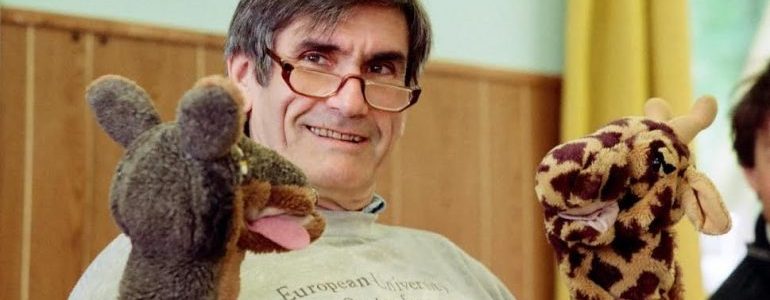
In Nonviolent communication, a distinction is made between a way of communicating that connects and a way that disconnects, using the giraffe and the jackal as metaphors. In another blog post, I discuss the meaning of these giraffe and jackal metaphors in detail. In the article below, I would like to share the origin of this metaphor with you, based on anecdotes collected by Pamela Beck and stories I heard during an NVC event in Finland in 2021 from CNVC trainers Towe Widstrand, Shona Cameron, and Hannah Savanna about their adventures during the years they traveled with Marshall Rosenberg.
How did the idea of the jackal and the giraffe come about?
While traveling through Europe in the 1990s to speak about his model of Nonviolent Communication, Marshall Rosenberg was often driven to and from the airport by workshop participants. One lady who frequently transported him had a tendency to vent about her husband’s unpleasant habits during the car ride. When Marshall was in the car with this woman once again, he lightheartedly asked her how things were going with her and “that old jackal” (“Are you still dealing with that old jackal?”). The woman reacted so strongly to this metaphor that she nearly drove off the road while shouting that this perfectly summarized what she thought of her husband: someone who was constantly trying to nip at her heels (“That’s exactly what he is — always nipping at my heels!”).
Marshall enjoyed the strong reaction this metaphor evoked so much that he began asking participants in his trainings who had a jackal in their life. The comparison was often received with laughter of recognition. He decided to keep the Jackal. When a student gifted him a jackal puppet during a break, he decided to use it. it brought a lot of humor and liveliness to the training. And so, the jackal puppet made its debut.
The jackal and the duck
Initially, the counterpart to the jackal was a duck. Marshall Rosenberg often used the duck in relation to responding to requests: “Please do only what I ask if you can do it with the joy of a child feeding a group of hungry ducks.” By this, he meant that one should only do something out of a genuine need to make life more pleasant for oneself and the other, so that giving and receiving become one. As soon as you do something out of shame, guilt, duty, fear, or to buy love, Rosenberg considered it a potential source of violence. You or someone else will eventually pay the price if you do something against your will.
However, during workshops, it was pointed out to Marshall that the small duck would never be a match for the much larger and stronger jackal when it really mattered. Therefore, the duck made way for the larger and stronger giraffe. The giraffe is the land animal with the largest heart, representing compassion, and the longest neck, representing a long-term perspective on the consequences of one’s actions. Furthermore, the giraffe lives on the leaves of the acacia tree, which it manages to find among sharp, mean thorns, much like the valuable feelings and needs a giraffe finds amidst judgments, reproaches, and other prickly remarks.
Explanation of the giraffe and the jackal
In the video below, Marshall Rosenberg explains the difference between the communication styles of the jackal and the giraffe with his characteristic humor. You can read more about who Marshall Rosenberg was in this blog post. A more extensive blog post about the meaning of the Giraffe and the Jackal can be found here. Want to read even more about the Giraffe and the Jackal? Justine Mol wrote the book ‘The Giraffe and Jackal Within’.