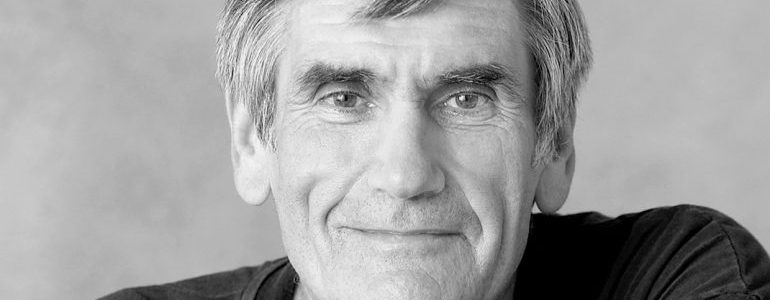
Who was Marshall Rosenberg? The American psychologist Dr. Marshall Rosenberg (1934 – 2015) is the creator of the proces of Nonviolent Communication. Marshall Rosenberg was born in Ohio, but he and his family moved to Detroit in 1943, which was the scene of severe race riots during those years. At times, they could not leave their home for days because it was too unsafe on the streets, and he was also confronted with aggression at school due to his Jewish name. From a young age, he wondered why people hurt one another and how they could derive satisfaction from the suffering of others.
Diagnosis or empathy?
In his search for answers to these questions, Marshall Rosenberg chose to study psychology, earned his doctorate, and worked as a psychotherapist. However, this did not provide the answers he was seeking. He did not feel at home in the role of a therapist. To him, diagnosing and labeling ‘patients’ did not do justice to the human being behind the label. He experienced greater success with clients when he paid attention by truly listening to them and showing empathy. This strengthened his conviction that people can help themselves when they feel supported by others and that we can trust that human beings possess a great inner capacity for healing. He stopped his work as a psychotherapist and developed the Nonviolent Communication model.
Violence according to Marshall Rosenberg
Violence, in Marshall Rosenberg’s definition, is broad. It can be directed toward another, but also toward oneself. It can be verbal or physical, but ignoring someone or thinking negatively about oneself are also forms of violence. According to Rosenberg, people do not become violent because they are sick or evil; rather, we can become violent toward ourselves and others when needs that are essential to us are compromised, such as the need for recognition, connection, or safety. Much violence is rooted in a mindset that seeks the cause of conflict in what is wrong with others. As a result, we are not always able to see our own contribution to conflicts. Marshall Rosenberg himself was not entirely satisfied with the term ‘Nonviolent Communication’ because, in his view, it emphasized what the method is not (violent) instead of what it is (connective).
Marshall Rosenberg’s sources of inspiration
Mahatma Gandhi (1869 – 1948) and Martin Luther King (1929 – 1968) were major inspirations for Marshall Rosenberg. His thinking was also shaped by psychologist Carl Rogers (1902 – 1987) who, along with Abraham Maslow (1908 – 1970), is considered one of the founders of humanistic psychology. Rosenberg studied and worked with Carl Rogers. Another well-known thinker in the field of interpersonal communication from the Rogers school is Thomas Gordon. His widely used ‘Gordon method‘ is primarily focused on communicating with children, but shares many commonalities with Nonviolent communication and remains popular. The acclaimed Eugene Gendlin (1926–2017), creator of the Focusing-Oriented Psychotherapy technique, also hails from the Rogers school.
Nonviolent communication training
In the Nonviolent communication training by Equanimity, you will learn how to handle emotions during conversations and how to truly connect with others. You will learn to recognize your feelings and needs and to formulate requests clearly. In the training sessions, you will practice with everyday situations so that you immediately experience the benefits of Nonviolent communication in your life.