
As a certified inclusion strategist and CQ facilitator, Vivian Acquah from Amplify DEI helps leaders and teams to break through barriers that hinder innovation and growth. In this blog post Vivian argues that structural provision of training courses in non-violent communication in combination with targeted inclusion training is a successful combination to prevent polarisation in teams.
Polarisation in the workplace
You read about polarisation in the news. You see division in political debates. You might think this phenomenon stays outside your office doors. Yet this division affects your workplace every day. A discussion about a new project can quickly turn into a battle. Colleagues no longer see each other as teammates. They develop a mindset where groups stand in direct opposition to one another. The differences of opinion within your team used to foster innovation and new ideas. Nowadays, they increasingly lead to an unbridgeable divide between people.
What starts as a tiny difference of opinion quickly escalates into a serious conflict. You see employees taking rigid stances. They approach complex situations in a completely black-and-white manner. This causes palpable friction within the department, with emotions simmering beneath the surface. Team members suddenly view each other as adversaries. They judge others solely on the basis of a differing opinion. They completely lose sight of the person behind that opinion.
Conflicts at work: the figures
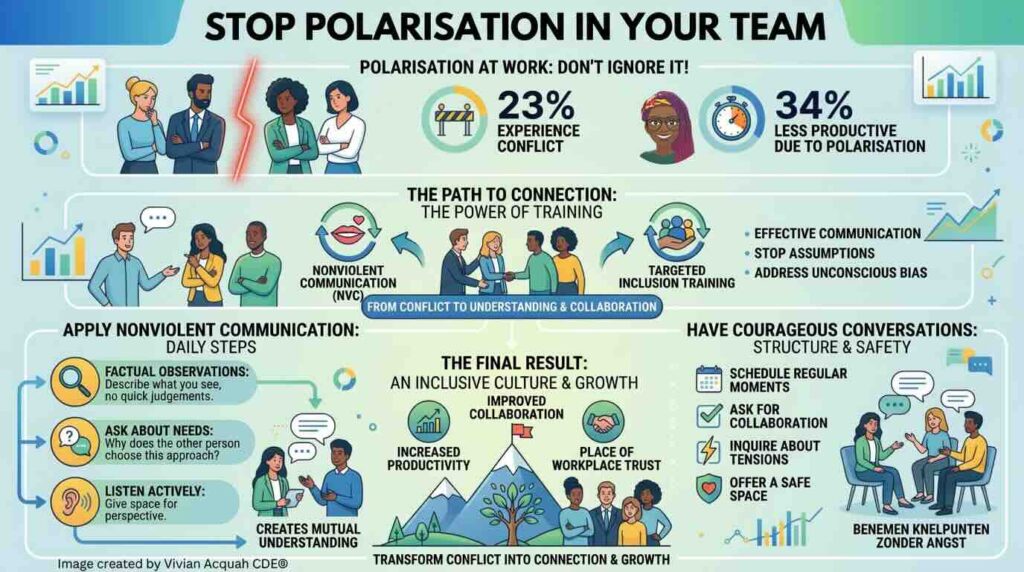
This is not a rare occurrence in the business world. According to the Randstad Employer Brand Research from the year 2025 shows that 23 per cent of the employees experience immediate problems due to conflicts at work. Almost one in the four people experiences therefore daily disruption. These conflicts hinder the cooperation within your organisation enormously.
Another figure from the same survey raises even more concerns. As many as 34 per cent of the staff indicate that polarisation is harming their personal productivity. You notice the consequences of this every working day. Colleagues withdraw themselves from group discussions. They avoid difficult or confrontational topics. They work simply much less effectively together on the goals of your company.
How diversity and polarisation are linked
Our society is characterised by a vast diversity. Different generations, cultures and deep-rooted beliefs coexist side-by-side with one another. This brings a rich palette of perspectives to your organisation. The composition of your workplace is constantly changing. The dynamics between employees inevitably change along with it. This unintentionally creates friction.
In the first instance, there arise some harmless differences regarding the sustainability policy or specific working methods. These differences are however quickly escalating. People cling to their own beliefs. They have the idea that they not understood or heard by their colleagues or the manager. They identify themselves exclusively only with their own side of the story. Invisible walls arise. Colleagues avoid each other actively or work against each other themselves. What an a55> open dialogue could have been is, escalates into conflict, frustration and exclusion.
Why you should never ignore polarisation
Ignoring the issue won’t solve anything for your team. As an inclusion strategist, I often come across situations where people within teams tend to sit back and wait or downplay the situation. They avoid the conversation. They do this out of fear of conflict or further escalation. However, polarisation never goes away on its own just by looking the other way.
Ignoring this friction directly undermines mutual trust. It destroys the psychological and social safety within your team. It harms long-term performance. It pits people against one another. Your teams need to stand shoulder to shoulder to achieve the business objectives. This requires a proactive attitude from you and your team members. You must be able to have courageous conversations in order to achieve productive and workable results.
The power of non-violent communication and inclusion training
How do you make the transition from polarisation to connection? The structural provision of training courses in non-violent communication in combination with targeted inclusion training has a significant impact. You work every day with people from diverse backgrounds such as age, ethnicity and gender. They have different work experiences and bring unique life experiences to the table. It is important that team members learn how they can deal with all these differences more effectively can communicate.
As a team member, you’ll also learn how to work together more effectively. This helps you avoid relying solely on first impressions. You’ll stop making assumptions based on rumours or stories from others. If you don’t do this, unconscious biases will end up influencing your team. You can tackle these biases effectively through targeted training.
Empathy and conflict management in the practical setting
Both training courses teach your team a great deal about fundamental empathy and practical conflict management. Your staff will learn how to give feedback without attacking the other person. They will learn how to express frustrations in a constructive way. They will discover that they can learn from one another every day. They will grow together as professionals. You don’t have to agree with every point of view. You can hold a completely different opinion and still fully respect the other person. Differences of opinion have a firm place in a healthy organisation. You will learn how to have a robust discussion without causing harm to the other person.
Practise non-violent communication every day
You put these training sessions into practical use with concrete steps. You focus from now on on factual observations instead of quick judgements (unconscious biases). Does a colleague approach a shared task differently than you? Then describe exactly what you see happening. Don’t immediately say that the chosen approach is wrong or silly.
Next, ask about your colleague’s underlying need. Perhaps your colleague has chosen a different method to save valuable time. Perhaps your colleague wants to avoid a specific risk. Listen actively to the answer. Give the other person space to share their perspective calmly. This immediately fosters mutual understanding. It defuses the tension in a potential conflict.
Courageous discussions for better cooperation
You work step by step towards a way of collaborating that is constructive and effective for everyone involved. You hold discussions that lead to a workable outcome for the whole department. You establish a clear framework for these difficult discussions. You schedule regular meetings with your team.
During these meetings, don’t just ask about the progress of ongoing projects. Also ask explicitly how the team is working together. Find out about any unspoken tensions that may be simmering beneath the surface. Provide a safe and open space. This allows team members to identify issues without fear of negative consequences.
Create a culture of trust
The end result of this approach is a working environment where diversity of thought is actively encouraged. Team members feel respected for their unique contributions. This leads to a strong and inclusive workplace culture.
You will see increased productivity thanks to improved collaboration and greater understanding. You are investing in the right training programmes. You are equipping your team with the essential skills to successfully transform destructive conflicts into lasting connections and growth.
Want to know more?
Have you become curious about how our training courses in the field of Diversity & Inclusion and Non-violent communication can strengthen each other and reduce polarisation within your a16> team or organisation against can lead to? Please feel free to contact Vivian Acquah from Amplify DEI or Boris Nauta from Equanimity and we would be happy to think along with you .