“Heyyyyyy! B-o-r-i-s -N-a-u-t-a!”. I am at the campsite in Groesbeek with my children, and a friendly-looking, stout middle-aged man approaches me with a broad smile. I have absolutely no idea who he is, or wait… does that face look familiar after all? He continues: “Canisius College, 5 VWO! I recognized that mischievous grin of yours immediately! How are you, man? It’s so good to see you again!”. The first thing I think is, “Who is this man and why on earth is he happy to see me?!”
Belonging
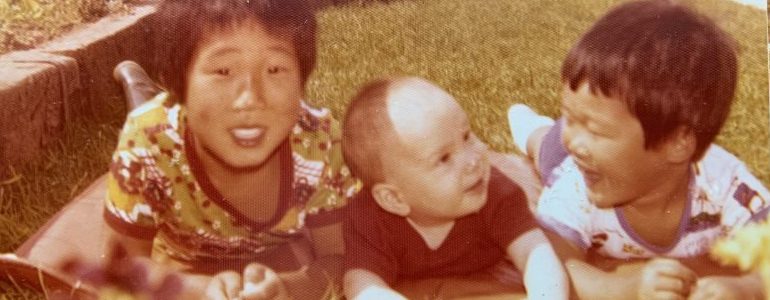
‘Belonging’ has always been a difficult subject for me. I grew up in a Catholic village with Protestant parents, along with my two Korean brothers and, for a short time, two Vietnamese foster children. In primary school, my classmates told me I was “import” and “elite.” I did not go to the fair, was not allowed to participate in the first communion, and while everyone else played football, I did judo. Once in secondary school, instead of “elite,” I was suddenly called a “communist” because I felt the need to stand up for my unemployed father during social studies classes. Fortunately, I found a connection elsewhere, in a group of friends from a childhood friend at another school, and with my sparring partners at the Pencak Silat school. At the age of 17 I walked around with my Indo friends dressed in a long blue raincoat with a button that said ‘Indo,’ even though my parents were very much of Dutch descent. That powerful and persistent feeling of “not belonging” continued in the years that followed at university and later at work. Wherever and with whomever I was, I considered myself an outsider.
But as I got older, something strange happened. Whenever I encountered people from the past, they invariably spoke about me and themselves in terms of ‘us’ and ‘we.’ To my astonishment, the memories they shared about us did not suggest at all that I hadn’t belonged. What was wrong here?! Had I missed something? As I began to look into it more and talk to others about it, I discovered that many people have doubts, to a greater or lesser extent, about whether they belong. It began to strike me that it was primarily I who projected myself outside of every group, seeking confirmation in many things that I was ‘different.’ I had adopted an identity of which ‘being an outsider’ was a significant part. It took me a long time to let go of this idea. Because, well, if you are not someone who doesn’t belong, then who are you?
Belonging to yourself
Brené Brown, known for her work on shame, wrote a beautiful book about belonging called ‘Belonging’ in which I gained two important insights. First, that growing up with the feeling that you do not belong in your family, despite all the good intentions of your parents, is a painful wound to sustain in your youth. It can lead to living in pain and doubt about whether you are allowed to exist later in life. If you do not acknowledge and give attention to this pain, you will try to numb it or take it out on others.
The other insight I gained from Brown’s book is that what is needed to feel that you belong lies within your own heart. If you learn to believe and accept that you are good exactly as you are, including all your shortcomings, then you will increasingly be able to feel that you belong. But as long as this feeling remains a reward for how you try to prove yourself through performance and perfection, by pleasing others and pretending to be someone else, you remain dependent on others for this feeling. And that means others can also take it away from you.
Although the feeling of being an outsider still surfaces occasionally, I now consider it more of a thought—something I tell myself, but which is not necessarily true. Mindfulness and Nonviolent communication helped me to view it from a different perspective. I also began experimenting by attending social gatherings or birthdays where I initially thought I had nothing to contribute, and they often turned out to be quite pleasant. I organized a BBQ at home for some colleagues, and we had a wonderful time together. Having children also helped; it is very difficult to feel like you do not belong when six doe-brown eyes look up at you expectantly. My ultimate conclusion is that you do not have to be the same as others to belong. In fact, it is quite the opposite. The very fact that you dare to be ‘different’ makes people appreciate your presence, because you are being ‘yourself’ with them. Some people might not like you as much because of it, but that is also perfectly fine. The feeling of belonging now comes from my heart. I belong to myself, and therefore I belong with everyone.
Image: my two big, sweet brothers and me in the summer of 1975